Guide
Jini Cultivation Guide: Natures, Talents, IVs and Bloodlines
Six stats, talent tiers, natures and how to change them, IV rerolls, bloodlines and awakening, plus weekly craft priorities.
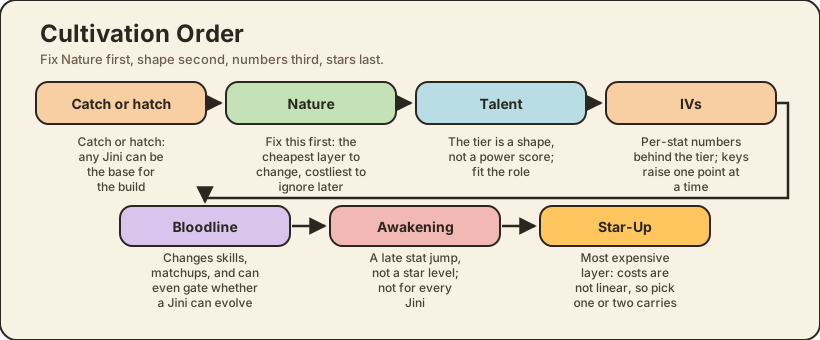
Cultivation has four independent layers, and doing them out of order wastes the scarcest items in the game. Fix Nature first, then Talent shape, then IV numbers, then Bloodline and stars. A Jini with the right Nature and an average Talent roll will out-perform an "Exceptional" roll whose boosted stats miss its job.
The six stats
Every Jini is scored on the same six stats: HP, Attack, Defense, Magic, Magic Defense and Speed (CN build, Season 3). Attack drives physical skills, Magic drives magic skills, and the two defenses split the same way. Speed sets turn order, which is why a fast support can decide a fight before your carry moves. HP is also a resource for some kits — Vargyr spends health to attack and heals it back through lifesteal.
| Stat | What it does | Who cares most |
|---|---|---|
| HP | Total health pool; some skills spend it | Tanks, Vargyr |
| Attack | Physical damage | Physical carries |
| Defense | Physical mitigation | Front-line tanks |
| Magic | Magic damage | Magic carries |
| Magic Defense | Magic mitigation | Supports, magic tanks |
| Speed | Turn order | Speed carries, buffers |
Global UI names may differ; the CN build uses these six. The combat system guide covers how they interact with energy and turn order.
Base stats decide the role before any roll does
Base stats are fixed for a species and never roll. The six-stat spread tells you which stats the Jini is built around, and therefore which Nature and which three IV slots you are hunting. A species with low Magic and high Attack will not become a magic carry because its label says Exceptional, and a defensive support with flat offences exists to absorb hits rather than deal them.
Assign the role first, then choose the trade:
- Damage dealer. Speed first, then the attacking stat the species actually leans on, then HP or whichever defence answers the common threats. A physical attacker with an unusable Magic stat wants its negative Nature on Magic, never on Speed.
- Support, interceptor or status unit. HP first, both defences second, and the attack stat it does not use as the dump. Bulk is the job.
- Bulky attacker. HP plus the attacking stat, with one defence in the third slot; physical defence is the more common choice (CN build, Season 3; players report).
Do not outsource the decision to the in-game usage panel. It is compiled from ownership rather than from PvP results: the fire starter shows an attack-boosting, Speed-cutting Nature only because that is what the story hands every player, while PvP builds the same Jini for Speed (players report). Use the panel as a starting point and check the role yourself.
Nature: 30 profiles, one decision
There are 30 Natures (CN build, Season 3). Each one raises one stat and lowers another, so a "perfect" Nature is simply one that boosts the stat your Jini uses and dumps a stat it never touches. Adamant raises Attack and lowers Magic; Brave raises Attack and lowers Speed; Timid raises Speed and lowers Attack. A support wants the opposite trade-off from a carry.
Nature is the first thing to check because it is the cheapest layer to fix and the most expensive to ignore. PvE tolerates "close enough"; PvP does not, because a wrong Nature compounds with every other multiplier.
- Gold Mirror changes the Nature outright. The main source is paid; event compensation has also granted them (CN build, Season 3).
- Silver Mirror only moves the Nature inside its existing boost, for example Brave to Adamant. One costs 15 Wish Stars through alchemy; shops also stock them.
- Cracked Mirror is the free weekly craft. It removes the negative half of a Nature but does not choose a new boost, so it rescues a good Jini with a bad penalty rather than creating a perfect one.
Talent tiers: the label is not the roll
The CN build sorts Talent into four tiers, and the tier describes how many stats are boosted and whether the Nature boost overlaps them (CN build, Season 3):
| Tier | Rule | Practical meaning |
|---|---|---|
| Exceptional | Three stats at +7 or more, and the Nature boost overlaps one of them | Best ceiling, but only if the three stats fit the role |
| Excellent | Three stats at +7 or more, with no overlap | Often as good as Exceptional for a specific build |
| Decent | Two stats at +7 or more, Nature boost random | Usable filler while you farm keys |
| Average | One stat at +7 or more, Nature boost random | Do not invest unless the Nature is perfect |
This is the most common trap in the game: players keep only Exceptional rolls and release Excellent ones that already have the right three stats. A mismatched Exceptional is worse than a matched Excellent, because the tier is a shape, not a power score.
Talent, IVs and the items that fix them
The CN sources use Talent and Individual Values (IVs) almost interchangeably, and the UI does not help. The practical split is: Talent is the tier and the set of boosted stats; IVs are the per-stat numbers behind it. Each boosted stat can reach +10, and every Silver Key adds +1 to one stat (CN build, Season 3; single source).
- Gold Key unlocks locked slots and can move a boost to a stat you choose. One per week through alchemy for 10 Wish Stars; shops also sell them.
- Silver Key raises the number, not the shape. Five per week from the Shining Contest, six per week from the Battle Academy perk, plus shops and events.
- Adaptation Key reshapes which stats the roll sits on. One per week through alchemy; use it before you spend Silver Keys, never after.
Order matters: fix the Nature, fix the shape with a Gold or Adaptation Key, then finish the numbers with Silver Keys. Doing it backwards burns keys on a roll you are about to reshape. The item rates just listed are CN build, Season 3. If you are spending a Prism Ball, remember it guarantees Exceptional Talent and three gold 10s, while a King Ball only guarantees the Exceptional label and does not raise IVs. The Gulu Ball guide covers which ball to use.
Reading a fresh catch: what the numbers are telling you
A new Jini presents four separate layers that get confused constantly: base stats, IVs, Talent tier, Nature. IVs are the per-stat roll, not the species spread. On the CN build they land between 7 and 10, no more than three stats carry one, and a Silver Key adds a single point (CN build, Season 3; players report). Three stats sitting at 8 therefore need six keys to reach the +10 cap, which is why the shape is worth more than the starting number.
What the label cannot tell you is fit, and what it does not lock you out of is repair. Both the tier and the Nature can be rebuilt with keys and mirrors, and the weekly sources for that work do not require payment (players report). So a good body under a weak label is a project rather than a write-off — but only invest when the three boosted positions already match the role. A high tier sitting on the wrong three stats is still the wrong three stats.
One last sorting habit from players who farm shinies: check the Nature before you check the numbers. A Nature change costs more than finishing an IV roll, so a Jini with the right Nature and a half-complete roll is the better long-term project. A male whose boosted stat positions fit a role is worth keeping even when his own species is not the one you plan to use, because the shape passes through his egg group while the numbers do not (players report).
Blessing: start an egg from a finished Jini
Blessing lets you reuse a roll instead of hunting a second copy. Hold an egg, pick a summoned Jini of the same species — yours or a friend's — and spend one Blessing Pendant; the hatched Jini then inherits that Jini's Nature, its trait and the shape of its Talent roll (CN build; one player's testing). The post says the pendant is sold only by the Traveling Merchant, so the system is limited by merchant stock rather than by a season counter.
Four limits decide whether a pendant is worth spending:
- Tagged eggs are excluded. Shiny, Radiant and Alpha eggs cannot be blessed. An ordinary egg of a season encounter Jini can be.
- The skin is not copied. You inherit the build, not the donor's Shiny or Radiant appearance.
- The Nature is the current one. If the donor was changed with a mirror, the changed Nature is what transfers.
- The numbers are rerolled. Only the shape of the Talent roll carries over, so the boosted stats match while the values underneath do not. Hatching with a Prism Ball, including the season version, is the post's fix for that gap.
Which Jini is worth blessing
The stated priority is a favourite first, then a Jini whose trait you want on a main, then a PvP piece. That order fits a copying system: blessing mass-produces a build you have already decided to use, so it rewards commitment rather than discovery.
Two trait mistakes are worth avoiding. A capture-boost trait only pays off on the Jini that actually throws the balls, so copying it onto a fighter wastes the pendant — the post endorses exactly one carrier, Sonic Hound. And Share, which is excellent on a support that follows you around gathering, is the wrong trait to copy onto the main you intend to fight with.
There is one case where blessing doubles as an appearance upgrade. If you already own a strong non-Radiant Jini, bless a fresh egg from it and hatch that egg with a Prism Ball; the build carries over, and the ball supplies the Radiant form the blessing refuses to pass on.
Bloodline: the layer that changes the build
Bloodline sits on top of stats and can change skills, matchups and even whether a Jini can evolve. Elemental bloodlines are applied with the matching Wishforce Strike and potions, which come mainly from flower-seed challenges and alchemy. The Universal Potion covers every bloodline except Alpha; the Alpha Potion costs 10 Wish Stars or 10 Alpha blood (CN build, Season 3).
Two examples show why bloodline is not cosmetic. Starfall Rabbit must switch to a Dark bloodline before level 32 or it cannot take its branch evolution, and Verdant Lady wants a Dark bloodline after evolving so it can learn Greed for sustain. A corrupted Jini that you purify becomes Strange Bloodline, keeps its special skill and original skin, but cannot enter PvP — a real cost if you planned to use it there.
Awakening and Leader Evolution
Awakening is a late stat jump rather than a star level. One CN guide awakens Vargyr after level 60 and reports it can then solo most NPC content (single source, CN build, Season 3). Not every Jini wants it: the same guide warns against awakening Emberkind Bug because its damage comes from Burn, which does not benefit from the awakening bonus.
Leader Evolution is separate. An Alpha bloodline opens it, and the Evolution Slate is bought from Annie's Shop. In battle the Jini takes its leader form with a passive — Qili Flower restores 7 energy per turn in that form — and some lines gain a wider skill pool; the story Platinum Unicorn can use seven skills as Rainbow Iris. Alpha eggs are usually Exceptional Talent, so they are worth the investment if you like the form.
Star-Up costs and where the materials come from
Stars are the most expensive layer, and the costs are not linear (CN build, Season 3; single source):
| Band | Cost |
|---|---|
| 1 to 5 stars | 900 Magic Dust, 88 Element Shards, a small amount of Roco Shells |
| 6 to 8 stars | 10 Soul Ring Seals, about 2.7M Roco Shells |
| 6 to 10 stars | 35 Soul Ring Seals, 2 Contract Essence, about 6.5M Roco Shells |
Magic Dust is the real bottleneck. A flower-seed run gives 30 Dust; the Annie's Shop and Vera's Shop exchanges plus their spending-tier rewards total 3,800 one-off, enough for about four 3-star Jinies (CN build, Season 3). Soul Ring Seals come from the Starlight Showdown (5 per week) and Territory Trial (8 per week), with 2 for a first clear of a Destined Flower Seed. Contract Essence is the rarest piece — one from the Territory Trial — so do not spend it on a Jini you are still testing (all values CN build, Season 3).
Weekly craft priority
- Gold Key — one per week; the only renewable way to fix a Talent shape.
- Cracked Mirror — one per week; rescues a good Jini with a bad Nature penalty.
- Silver Keys — buy out the Shining Contest and Battle Academy stock before anything else; they finish rolls you have already shaped.
- Bloodline potions — only when you are committing to a specific evolution or PvP build.
- Star-Up materials — last, because stars amplify a good roll and waste a bad one.
If you follow that order, most of your roster will sit at 1–3 stars and still clear PvE, while one or two carries get the deep investment. That is intentional. See the Jini Dex guide for which Jinies deserve it, and the evolution guide for bloodline-gated evolutions. The tips page has the one-line version of the nature and IV rules if you need a reminder mid-run.