Guide
Shiny, Radiant and Nightmare Jinies Explained
Shiny, Radiant and Nightmare-corrupted variants: how each is obtained, the 80-catch pity, Prism Balls and breeding.
Roco Kingdom separates three things players often lump together. Shiny is the rare recolour. Radiant is the brighter premium recolour. Nightmare-corrupted is a corrupted state that appears during a hunt and can be kept or cleansed. "Prismatic" in the page title is the umbrella term for the two colour variants, not a fourth rarity.
They are not equally rare and they do not share a farming method. Shiny is a long chain with a hard pity, Radiant comes mostly from premium balls and reward eggs, and Nightmare-corrupted is a mid-fight decision.
The three variants at a glance
| Variant | What changes | Main route | Rarity |
|---|---|---|---|
| Shiny | Palette only | Repeat captures, Nightmare Shackles, defeat the corrupted Jini, then roll | Very rare, season-limited |
| Radiant | Palette only | Prism Ball captures, reward eggs and special balls | Moderate |
| Nightmare-corrupted | Corrupted palette, fixed skills, guaranteed top talent | The same repeat-capture chain; keep or cleanse | Common once the chain fires |
A Jini can be Shiny and Radiant at the same time. It cannot be Shiny and corrupted at the same time (CN build, Season 3; single source).
Shiny hunting and the 80-encounter pity
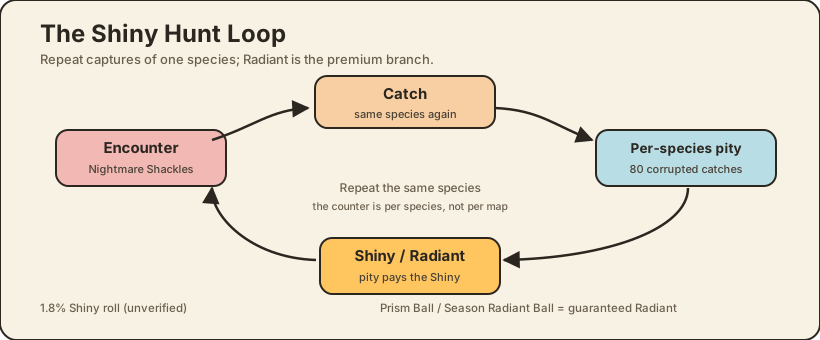
Shiny hunting starts with repetition, not with a ball. Catching the same species again and again eventually triggers Nightmare Shackles: a corrupted version of a wild Jini appears, black and visibly wrong. Beat its first health bar and the encounter resolves.
If you clear the corruption, the game rolls for a Shiny. The figure used by the community is 1.8% (unverified), with the remaining 98.2% resolving as the ordinary form. That number comes from a single English fan source with no date, so treat it as an estimate rather than a rule.
The rule that carries the hunt is the per-species pity. Every species keeps its own counter, and 80 corrupted encounters of that species guarantee its Shiny (CN build, Season 3). The counter belongs to the species, not to the element, the map or your account.
Pools and counters
Corrupted encounters resolve into a family pool, an element pool or the random pool. A rare Jini that wanders into your hunt comes from a different pool and does not spend the progress of the species you are farming. That is why two players can report completely different ball counts for the same target.
Season 3 changes the edges rather than the core. Element pools with no Shiny of that element become random pools, and a region can boost the appearance rate of that season's encounter Jinies (CN build, Season 3). The 80-encounter counter still applies to the species you are actually catching.
Unlock the fruit first
Catch 20 of a species' highest evolution to unlock its fruit (CN build, Season 3; single source), then place the fruit in a sanctuary to skew spawns toward that species. Seasonal encounter Jinies do not get their fruit until roughly week six, so early in a season you mix two families of the same element or wait (CN build, Season 1; single source).
Routing a hunt into a single pool
Knowing that a corruption resolves into a family pool, an element pool or the random pool is only half the job; the other half is controlling which of them your catches feed. Testers on the current CN build report a one-way rule: repeated catches of one species credit the element pool of its first type only, even when the species carries a second type. The second type does not open a second pool on the way in, but on the payout side a species qualifies when either of its types matches the pool (CN build, Season 3; community testing).
First types that have no seasonal Shiny of their own do not form an element pool at all in this build. Catches of those lines are reported to fall through to the large mixed pool, which draws from every seasonal Shiny at once, so a hunt there is broad rather than targeted (CN build, Season 3; single source).
The method players settled on is the opposite of mixing: pick one line without a Shiny of its own, catch its normal and corrupted forms over and over, and let the first type carry the progress. Circulating datamined figures put the composition of corruptions in such a hunt at more than 70% for the fruited species and its earlier form, around 7% for the seasonal Shiny of the same element, and about 2% for a different element. None of that is confirmed, and nothing in the game tells you the route exists (CN build, Season 3; community testing).
Pool choice matters more than catch speed. Four element pools are reported to hold exactly one seasonal Shiny each — Ghost, Light, Earth and Water — which makes entry almost a straight line to the form you want. Pools holding two or three candidates can pay out the wrong one, and players only accept that risk when the alternative is a line they cannot farm comfortably (CN build, Season 3; community testing).
Corruption markers on the map are a reading aid, not a probability boost. Each pool contributes at most one marker for a given species, so a second identical marker can come from the element pool or from the general pool just as easily as from the Shiny table. That is why two markers sometimes end in an ordinary Jini. Checking the second marker cuts the time spent entering fights; the pity counter still decides the outcome (CN build, Season 3; community testing).
The route is also meant to pay for itself. High-value lines are marked with a base recall payout of 3,000, 4,200, 4,500 or 6,000 Roco Shells, and players pick the most expensive line they can catch reliably so that ball costs sit below the return; a few report the payout occasionally running ahead of the spend. Flower farming is the other funding route: blooms are produced only during the roughly 20-minute in-game day, the world cap is 10 plants, or 20 blooms, per minute, and one player measured 1,000–1,500 blooms an hour once a second account handled the interaction (CN build, Season 3; single source).
Nightmare Shackles and corrupted encounters
The event triggers from repeated captures, not from a timer or a location. Once it fires, the corrupted Jini is a normal wild encounter with a black model and a first health bar. Defeating it is the gate to every outcome.
If you keep the corruption, you keep a Nightmare form: guaranteed top-tier talent, four fixed skills and one strange skill the species cannot normally learn (CN build, Season 3; single source). You cannot catch it with a Radiant Ball, and its skills cannot be changed.
If you cleanse it, the Jini returns to its normal palette. Cleansing keeps the talent and the strange skill, lets you change skills again and leaves a special bloodline; one source adds that a cleansed Jini cannot enter PvP (CN build, Season 3; single source). The Purification Potion comes from defeating the men in black or from releasing other corrupted Jinies.
The order matters. The Shiny roll sits in the cleanse branch, so decide before you commit: keeping the corruption gives you a fixed, high-talent Nightmare form, while clearing it gives you the 1.8% Shiny chance.
Egg-group boxes and the box-exclusive Shinies
On top of the pools sits a second layer that players call the egg-group pool. It is described as a hidden-condition lucky box in three colours, and each colour can produce one Shiny that appears nowhere else. The model comes from player testing rather than from an official explanation, so treat the name and the boundaries as working theory (CN build, Season 3; community testing).
Box colour tracks egg group, not element. Yellow is reported for the animal, giant, amphibian, dragon and earth groups; blue for machine, sky, magic, ocean and plant; red for humanoid, fairy, amorphous and insect groups along with the non-breedable ones. What you mix decides which colours can appear: lines from one colour class keep that colour, two different classes produce both, and a pair covering all three classes can roll any of them. Every box appearance is reported to roll separately between the ordinary table and the box table, so one hunt can produce either on each trigger (CN build, Season 3; single source).
These three Shinies cannot be pulled from an element pool, and players report that they do not consume the element or family pity, which makes a box Shiny a bonus rather than a detour. Whether they spend mixed-pool progress is unclear. One test put the box share of Shiny appearances near 20%, another at 20–30%, and long stretches without a box Shiny are normal; the same testers say the boxes raise the duplicate rate and delay the pity on the pool you were actually running (CN build, Season 3; community testing).
Two consequences follow. Most of the easy-to-catch lines sit in the yellow class, so yellow boxes dominate a mixed hunt and players plan around suppressing that Shiny first. And there is still no confirmed way to force a box Shiny: the lines the game itself suggests, dual-element mixes and dual-egg-group mixes have all failed to produce one on demand. Any guaranteed box route should be read as unconfirmed (CN build, Season 3; community testing).
Prism Balls and Prism Shards
A Prism Ball does three things at once: it catches the target, guarantees top-tier talent and sets three of its IVs to 10 (CN build, Season 3; single source). It also produces a Radiant version. At launch the ball was listed at 160 RMB each (CN build, launch; single source), which is why players treat it as a budget item rather than a capture tool.
Spend it on something you cannot fix later: a legendary, a perfect egg Jini you intend to build, or a Shiny you specifically want. Do not spend it on a common wild Jini whose IVs you can improve through breeding.
Prism Shards are the free route to more balls. Documented sources include daily stamina conversion, the Destined Flower Seed track inside the Hero Medal Codex, Starlight Showdown and the Season Pass. A Monthly Card adds 4,500 shards over its cycle (CN build, Season 1; single source). Seasonal totals of 10,160 shards for free players, 18,560 with a Monthly Card and 19,760 with both are a fan estimate for the current season, not an official cap.
Breeding and variant inheritance
Breeding is the slow route, and the only one that keeps working after a season ends. Put a male and a female of the same Egg Group in two Home nests. The egg hatches the mother's species, so the father is the parent you use to inject a variant.
A Shiny or Radiant father raises the chance of a Shiny or Radiant egg; most eggs still come out ordinary, and the odds are low enough that this is a background project rather than a farm (CN build, Season 3). Shiny and Radiant eggs cannot be gifted. Ordinary eggs can be gifted once a day.
Egg groups were adjusted during Season 1, so ignore older charts. Legendaries, Dimo and the Season Pass Jinies sit in unknown egg groups and cannot be bred at all, which means their seasonal Shinies have to be hunted during the season. The breeding guide covers the nest setup and egg groups.
Do variants change stats?
Shiny and Radiant are cosmetic. They do not add stats, change typing or alter skills. A wild Radiant has random IVs, so a Radiant catch is not automatically a good build (CN build, Season 3; single source).
Nightmare-corrupted is the exception: it arrives with guaranteed top-tier talent and a fixed skill set, so it changes what the Jini can do. That is a property of the corrupted state, not of the colour.
The guaranteed talent on a Prism Ball capture comes from the ball, not from the Radiant look. If you want power, buy the ball; if you want the palette, run the chain. Do not pay a premium for a Shiny and expect a better stat line.
A weekly route that respects your time
- Pick one species with a seasonal Shiny you actually like.
- Unlock its fruit with 20 highest-form captures, or wait for the season fruit.
- Place the fruit in a large sanctuary and hunt around it.
- Bring a friend: hand-holding raises capture odds and shares Roco Shells.
- Use Advanced or Element balls and save your Prism Balls. The Gulu Ball guide covers the tiers.
- Defeat every corrupted spawn and count them; at 80, the species pity pays out.
- Before the season ends, breed a compatible male Shiny if you want the form later.
Two sanity checks keep the hunt cheap. Confirm that the species actually has a Shiny in the current season before you commit, and check the Jini Dex for which form you are targeting. If the form is not listed, you are farming a counter that cannot pay out.